This weeks reading is brought to you by the WSJ.
http://www.nytimes.com/2013/02/24/magazine/the-extraordinary-science-of-junk-food.html?pagewanted=all&_r=4&
Read it or else.
Monday, February 25, 2013

Saturday, February 16, 2013
How many calories - Redux

Believe it or not, being healthy is not actually about weight. You don't REALLY care what the numbers are. You just want to feel good and look good. Eating the right amount of calories is the KEY to both losing weight and gaining weight (if that's your thing). More importantly, the quality of those calories will determine how you FEEL. No matter how thin you get, you will feel like garbage if you keep eating garbage. Write this down: "My stomach is NOT a trash compactor"
If you’ve been storing away fat like a bear getting ready for winter, it means you’ve been eating more than your body needs. That part is obvious. The part we forget is that getting unhealthy happens slowly. Barring some kind of alien abduction scenario, you probably won't wake up one morning 200 pounds heavier than the previous day. Fat grows silently over time. Like a flower, or love or a tumor. You became unhealthy slowly and you're going to improve it slowly.
How Many Calories do I Need?
BMR stands for Basal Metabolic Rate. Let’s say you were trapped on a mysterious island after a plane crash. Your Basal Metabolic rate is the minimum amount of coconuts you need to eat so that you don’t DIE. Our bodies need calories to keep our organs running, to power our massive energy sucking brains, and to keep our cells and muscles functioning.
Click the link below to open a BMR calculator. Enter your current information to figure out your current Basal Metabolic Rate. Or, if you have my excel metabolic calculator you can just use that.
http://www.bmrcalculator.org/
Put in the following stats for a fake person. Let's call them... Professor Guggenheim. Age 25, Female, 150 pounds, 5 foot 9 height.
The calculator says Professor Guggenheim has a BMR of around 1491 calories per day. That’s the amount of calories that would keep her from looking like Skeletor and dying of a starvation heart attack. The problem with that BMR number is that we want to do MORE than just be minimally alive. We want to do awesome stuff like swimming with dolphins, fire dancing or reading People magazine. So Professor Guggenheim needs to bump that calories number up a bit.
The Harris Benedict Equation
Since we want to do more than just not die, we need to add calories to our BMR to get the amount of calories our body needs for our level of activity. There are calculators that use body fat % to determine your calories and these are much more accurate.
1. If you sit on your rear all day and do basically nothing active, multiply your BMR by 1.2
2. If you do light exercise 1 to 3 days per week, multiple your BMR by 1.375
3. If you do moderate exercise 3 to 5 days per week, multiple your BMR by 1.55
4. If you do heavy exercise 6 to 7 days per week, multiple your BMR by 1.725
Let's say Professor Guggenheim exercises 3 times per week; we would multiply her BMR by 1.55 to get 2,311 calories per day. This is the amount she needs to maintain his current body. You should NEVER EVER eat below 1.2 times your BMR. Anything less than eating at the sedentary level is a starvation diet and will only HARM you in the long run. You will lose weight, but it will not be permanent because your body will eventually realize you are starving and it will fight the weight loss by slowing your metabolism and digesting your muscles. And the more muscle you lose, the harder it will be to not look like you are made of marshmallow. So never eat below 1.2 times your BMR.
Start by deciding you want to feel better. Calculate the number of calories you should be eating and just eat that. We'll worry about eating better foods later. For now, just get your eating portions in control.
Monday, February 11, 2013
Eating Strategies
Author: Darci 2/11/2013
 As we all take a critical look at ourselves and our health, there are many questions that
naturally come up. Questions such as: What type of exercise is best? How often should we
exercise? How do I make time for exercise? How to I monitor or track my progress? What are
my goals? These are all questions that may enter our minds when considering ways to improve
our health. However, the answer to all of those questions is secondary compared to the answer
to this question: What should my diet be like? In this memo I’d like to share some trending
eating strategies that I’ve read about recently. All of them have been effective for various
reasons and for various types of people. I’d like to share these strategies to get you thinking
more critically about what you eat and how you plan your meals for the day.
Strategy #1 – Intermittent Fasting:
A relatively new strategy that has surfaced that promotes weight loss is called Intermittent
Fasting (IF). As the name suggests, the main point behind the strategy is to frequently take part
in fasting periods followed by a period of calorie consumption. For example, one sample of this
strategy suggested fasting every day from 8PM until noon the next day. That’s an overnight fast
that totals 16 hours of basically no calorie intake. Beginning at noon you would eat your first
meal of the day. The second meal would come between the hours of 3?5PM with the final meal
being consumed a little prior to 8PM. Exercise should be planned into your schedule sometime
before or after the second meal of the day. The beauty of this diet strategy is that you aren’t
restricted to certain foods when you do decide to eat. That doesn’t mean you should go nuts at
McDonald’s or Burger King, but it’s also not forbidden from time to time. During the fasting
hours from 8PM until noon the next day, it is highly recommended that you drink plenty of
water to stay hydrated. A very low calorie drink is allowed in the morning such as black coffee
but the main idea is to keep calories restricted until after 12PM. It should be noted that the
preferred type of exercise that should accompany this diet strategy is resistance training.
Strategy #2 – Carb Back-loading
Carb back-loading (CBL) refers to the time of day when most of your carbohydrates should be
consumed. It is recommended that you eat little to no carbohydrates in the morning and
afternoon hours. It is then suggested that resistance training be done sometime in the hours
between lunch and dinner. Once your workout is complete for the day, you are more than
welcome to go nuts on carbs for the rest of the evening hours. This even means desserts and
other high-carb options are perfectly acceptable when following this strategy. As with
Intermittent Fasting, the preferred type of exercise is resistance training. While walking,
jogging, cycling, and other forms of exercise aren’t frowned upon, both of these eating
strategies suggest that you’d get the most bang for your buck by taking part in resistance
training. And more specifically, the heavier weights you can lift, the better! This doesn’t mean
you need to be a World’s Strongest Man, but it does mean you should challenge yourself with
the heaviest weights you can handle for sets of 3-8 repetitions.
Strategy #3 – Carb Cycling:
Carb Cycling (CC) takes a slightly different approach to calorie restriction than IF or CBL. CC is a
weekly plan rather than a daily concept. With CC, it is suggested that you have some cycle of
days where you have no/low carbs one day, low/moderate carbs another, and moderate/high
carbs on another. Rather than trying to explain this concept further, take a look at two samples
of CC that could be used as a weekly cycling structure:
* Monday = No Carb
* Tuesday = Low Carb
* Wednesday = High Carb
* Thursday = No Carb
* Friday = Low carb
* Saturday = High Carb
* Sunday = Low Carb
OR
* Monday = Low Carb
* Tuesday = No Carb
* Wednesday = Low Carb
* Thursday = High Carb
* Friday = No carb
* Saturday = High Carb
* Sunday = Low Carb
As with any approach to your diet, eating should be done with intention and attention. The
bottom line is that weight management is not just about what you eat, but also how you eat.
What may work for one person might not be the best option for another. As a Wellness
Committee Member, I am not claiming to be a dietician or fitness expert. Accordingly, these
approaches may not be the best for YOU. I suggest doing your research before beginning any
fitness routine or making drastic changes in your diet.

naturally come up. Questions such as: What type of exercise is best? How often should we
exercise? How do I make time for exercise? How to I monitor or track my progress? What are
my goals? These are all questions that may enter our minds when considering ways to improve
our health. However, the answer to all of those questions is secondary compared to the answer
to this question: What should my diet be like? In this memo I’d like to share some trending
eating strategies that I’ve read about recently. All of them have been effective for various
reasons and for various types of people. I’d like to share these strategies to get you thinking
more critically about what you eat and how you plan your meals for the day.
Strategy #1 – Intermittent Fasting:
A relatively new strategy that has surfaced that promotes weight loss is called Intermittent
Fasting (IF). As the name suggests, the main point behind the strategy is to frequently take part
in fasting periods followed by a period of calorie consumption. For example, one sample of this
strategy suggested fasting every day from 8PM until noon the next day. That’s an overnight fast
that totals 16 hours of basically no calorie intake. Beginning at noon you would eat your first
meal of the day. The second meal would come between the hours of 3?5PM with the final meal
being consumed a little prior to 8PM. Exercise should be planned into your schedule sometime
before or after the second meal of the day. The beauty of this diet strategy is that you aren’t
restricted to certain foods when you do decide to eat. That doesn’t mean you should go nuts at
McDonald’s or Burger King, but it’s also not forbidden from time to time. During the fasting
hours from 8PM until noon the next day, it is highly recommended that you drink plenty of
water to stay hydrated. A very low calorie drink is allowed in the morning such as black coffee
but the main idea is to keep calories restricted until after 12PM. It should be noted that the
preferred type of exercise that should accompany this diet strategy is resistance training.
Strategy #2 – Carb Back-loading
Carb back-loading (CBL) refers to the time of day when most of your carbohydrates should be
consumed. It is recommended that you eat little to no carbohydrates in the morning and
afternoon hours. It is then suggested that resistance training be done sometime in the hours
between lunch and dinner. Once your workout is complete for the day, you are more than
welcome to go nuts on carbs for the rest of the evening hours. This even means desserts and
other high-carb options are perfectly acceptable when following this strategy. As with
Intermittent Fasting, the preferred type of exercise is resistance training. While walking,
jogging, cycling, and other forms of exercise aren’t frowned upon, both of these eating
strategies suggest that you’d get the most bang for your buck by taking part in resistance
training. And more specifically, the heavier weights you can lift, the better! This doesn’t mean
you need to be a World’s Strongest Man, but it does mean you should challenge yourself with
the heaviest weights you can handle for sets of 3-8 repetitions.
Strategy #3 – Carb Cycling:
Carb Cycling (CC) takes a slightly different approach to calorie restriction than IF or CBL. CC is a
weekly plan rather than a daily concept. With CC, it is suggested that you have some cycle of
days where you have no/low carbs one day, low/moderate carbs another, and moderate/high
carbs on another. Rather than trying to explain this concept further, take a look at two samples
of CC that could be used as a weekly cycling structure:
* Monday = No Carb
* Tuesday = Low Carb
* Wednesday = High Carb
* Thursday = No Carb
* Friday = Low carb
* Saturday = High Carb
* Sunday = Low Carb
OR
* Monday = Low Carb
* Tuesday = No Carb
* Wednesday = Low Carb
* Thursday = High Carb
* Friday = No carb
* Saturday = High Carb
* Sunday = Low Carb
As with any approach to your diet, eating should be done with intention and attention. The
bottom line is that weight management is not just about what you eat, but also how you eat.
What may work for one person might not be the best option for another. As a Wellness
Committee Member, I am not claiming to be a dietician or fitness expert. Accordingly, these
approaches may not be the best for YOU. I suggest doing your research before beginning any
fitness routine or making drastic changes in your diet.
Thursday, February 7, 2013
Healthy Breakfasts

You wouldn’t make it far from your driveway on an empty tank of gas, so why would you leave the house without filling up your tank first? Eating a healthy breakfast is no different for our bodies. A good breakfast fuels you up and gets you ready for the day. Breakfast is important because it is what your metabolism is based on for the day. If you give your body fuel to burn early on, it will burn more calories throughout the entire day.
So, you are probably wondering what a nutrient-dense breakfast consists of. The main focus is eating a breakfast that is filling and has the proper nutrients to satisfy you until your next meal. If there is any meal where you want to load up on protein and complex carbohydrates, it is breakfast, not only because proteins and complex carbs are filling, but because you have the entire rest of the day to burn the provided calories. Eating a complete breakfast sets the pace for the day since you won’t be as inclined to over-eat at other meals.
Often, breakfast foods are high in sugar and other simple carbohydrates which do not provide the necessary nutrients to get you through the day. So here are some tips and helpful hints on what a nutrient-dense breakfast should look like:
- Include whole grain products instead of refined products
- Choose low-fat dairy products (skim milk, low?fat yogurt and low?fat cheeses, such as cottage cheese and natural cheeses).
- Limit intake of fried foods, grease, and extra gravies/sauces
- Aim to include fresh fruit at breakfast rather than fruit juice, which can be high in added sugars.
- Make sure your breakfast includes:
- Complex carbohydrates (such as whole grain cereal, whole grain bread, wheat bread or fruit)
- Protein (such as eggs/egg whites, peanut butter, lean meat, poultry or fish or nuts)
- Healthy fat (such as peanut butter, nuts, light cream cheese)
300 Calorie Breakfasts at Home or On-the-Go
1 pack Nature Valley granola bars, handful of nuts, 8 oz skim milk
1 mini whole wheat bagel w/ 1 Tbsp light cream cheese, 1 small banana, 4 oz skim milk
1 wheat English muffin toasted w/2 slices lean ham, 1 slice of 2% cheese, ½ cup sliced fruit, 4 oz skim milk
Carnation Instant Breakfast/Protein Shake, 1 pack Nature Valley granola bars
400 Calorie Breakfasts at Home or On-the-Go
1 cup cereal w/ ½ cup skim milk, ½ cup sliced fruit, handful of nuts, 1 string cheese
1 slice wheat toast, 1 Tbsp peanut butter, 1 fruit, 8 oz skim milk
Yogurt cup w/ handful of nuts, ½ cup sliced fruit, 1 wheat English muffin w/2 slices of lean ham
Carnation Instant Breakfast /Protein Shake, 1 pack Nature Valley granola bars, 1 banana, 1 yogurt
500 Calorie Breakfasts at Home or On-the-Go
1 whole wheat bagel w/ 2 Tbsp light cream cheese, 1 small fruit, 8 oz 2% milk
2 whole wheat waffles w/ 2 Tbsp butter, drizzled with syrup, 1 string cheese, 8 oz skim milk
1 wheat English muffin w/ 2 cooked egg whites, 2?3 slices lean ham, 1 slice 2% cheese, 1 small fruit, 8 oz 2% milk
1 pack Nature Valley granola bars, 1 small fruit, 2 string cheese, 8 oz 2% milk
Wednesday, August 22, 2012
The Myth of Target Heart Rate
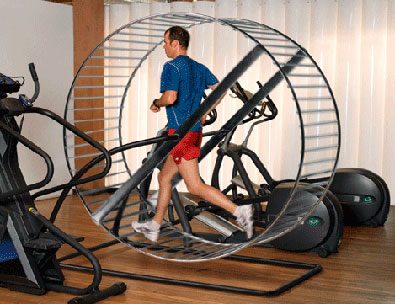
The myth
It started decades ago, and some people still believe it: If you want to lose fat you need your heart
rate in the ‘fat-burning zone’ and for cardio health you need to be in the
higher ‘cardio zone’. Like all crap
science, it sounds good but is wrong.
The science
There are no target heart rate zones.
Treadmills have those stickers on them because people want to see
them. They are nonsense and you can
ignore them, with one caveat. There are
medical reasons to not exceed certain heart rates. Ask your doc if this might apply to you.
Conclusion
Low intensity doesn't mean you only burn fat and high intensity doesn't mean you are burning all carbs. You will burn fat and carbs in varying proportions, but the overall
calorie burn will be higher when you work out harder. Duh.
Working out harder will have a greater affect on fat loss than staying
in some magical fat burning zone. Your
best measure on if you are working out hard enough is how you feel, not some
arbitrary target heart rate sticker.
Wednesday, June 20, 2012
Getting Treatment for Your Neck
Many medical procedures carry risk.
We’ve all seen the drug commercials on TV with long, speedy disclaimers
that the drug might make you wet yourself or stop your heart or something. We do these things to ourselves because the
benefits are greater than the risks involved.
For example, the risks of taking Plavix (fatigue, easy bruising) seem
pretty small compared to the benefit of preventing stokes. In medical areas, good science means taking a
look at various treatments and deciding whether the benefits are greater than
the risks.
There Are Other Risks
What’s the point?
Scientific support for chiropractic treatments as a whole is iffy. In fact, even the concepts behind chiropractic are fairly iffy. Overtime, scientific evidence will continue
to collect, but for now the best we can do is follow the evidence.
My neurologist told me some time ago that there is growing evidence
that chiropractic adjustments to the neck are linked to strokes and arterial
damage. A lot of medical treatments have risks, so that doesn’t bother me too
much. Because I am inclined to follow
the evidence, I want to know:
1.
Is it true that neck manipulations are connected
to strokes and arterial damage?
2.
If it is true, do the benefits outweigh the
risks?
The British Journal of Medicine (BMJ) publish an article on June 7th
2012 asking these very questions. The
researchers did a systematic review of this area, which means they gathered all
the data points they could get, to see if any indicators could be found or
conclusions drawn.
Problems
Nobody has done a randomized, double-blind study to see if people who
get chiropractic neck treatment have stokes.
That would be a fast way to be charged with ethical violations.
The next problem is that when someone has a stroke, most of the time nobody
is going to ask them if they have been seeing a chiropractor. For that reason, the number of strokes
related to neck manipulations is highly likely to be underreported.
On the other hand, just because two things seem correlated, does not
mean one is causing the other. As the
JREF article (below) points out, some chiropractors counter that people had
arterial damage and neck pain already; that’s why they came for treatment. That sounds like baloney to me. If they know someone has arterial damage why
in the world are they doing neck adjustments on them!?
Are Neck Manipulations Linked to
Strokes and Damage?
The answer is: yep! It turns out
that jerking the neck around has been correlated with arterial damage and
strokes. According to the BMJ article,
the rate of damage to the artery from these neck adjustments is between 1 in 400k
to 5.8 million manipulations. Compared
to other medical treatments, this doesn’t seem like a big risk. On the other hand, death from stroke is a
pretty bad outcome if you are only seeing a chiropractor for headaches or a
sore neck. So overall, I would consider
the riskiness pretty high: even though the absolute risk is low the severity is
high.
Do Benefits Outweigh the Risks?
Basically, studies have shown that there is no measurable benefit to
neck manipulation (PubMed 1-4). Other
studies have shown that getting your neck cracked by a chiro was no better than
applying tape to the neck (PubMed 5 below).
I should point out that there was no placebo in that study, so just remember
that they were comparing two treatments – they weren’t actually testing if the
treatments work. Neck adjustments work
as much as tape. And what is the
downside to taping your neck? None. Well, maybe some skin irritation.Monday, June 4, 2012
Apps for your health
Below is a list of some apps I've tried out, or thought people may be interested in. Links are provided below for itunes, but many of these apps are also available for android phones. There are a zillion health apps out there and a lot are low quality, so do some reading before you throw your money around.
Your mental and physical health is an important part of your life, so be willing to spend a few bucks on it. This list is just a handful of apps that I have found helpful.
Of course, if you want a great app for your health, take a look at twitter! There are a ton of people getting healthy that would love to tell you all about it! Check out our wellness twitter account: @hbmwellness
Of course, if you want a great app for your health, take a look at twitter! There are a ton of people getting healthy that would love to tell you all about it! Check out our wellness twitter account: @hbmwellness
 THI
Trainer - $2.99
THI
Trainer - $2.99
This is a
comprehensive program for building, recording and personalizing workouts.
Pros: You tell it what muscles you want to work and
you can see a list of exercises and even watch videos on how to do the exercise
properly. You can follow their pre-made
workouts or build one of your own. You
can also see graphs of how your strength/endurance have improved over time. There is a free version if you want to try it out.
Cons: It's a big app and you can get a little lost if you are new to exercise. The app is geared towards weight lifting, which may not fit your goals.

Restaurant
Nutrition – FREE!
This app has
nutritional information for over 30,000 foods at more than 200
restaurants! This is really useful when
you are traveling for work. Just because
work makes us travel doesn’t mean we have to get fat while we do it. It’s not perfect, but it’s pretty helpful.
Pros: It’s pretty
straight forward to use, and it’s free!
Cons: The ads can be
annoying and it doesn’t have all menu items for the restaurants.
Lose It! –
FREE!
This is a fantastic
app to anchor your health goals. There
are a lot of apps like this, but I think this is one of the easier apps to
use. It tracks your food, exercise,
weight, and all sorts of stuff.
Pros: It has a
ginormous database of foods built in and it’s pretty easy to add your own
foods. You can also add friends to help
you stay on track with your goals. It
also roughly estimates the calories you burn doing various exercises, and can
provide all sorts of helpful graphs.
Cons: It’s a inaccurate
on calculating how many calories you should be eating, so you’ll have to
manually adjust the numbers periodically.

HeartWise - $.99
A simple little app for tracking your blood pressure and
resting heart rate. I like to measure
how I am benefitting from my exercise and resting heart rate is one factor I
look at.
Pros: It’s a no
frills stat tracker that docs love cuz it tracks your blood pressure history for you. It even has an area for comments on the days stats (if you need it).
Cons: It’s boring,
but it does the job.

Pushup Fu - $.99
Train to do 100 pushups in a single sitting! Challenge friends and move up the ranks. If you don’t know how to do pushups at all,
this app will teach you how it’s done PROPERLY and then give you a pre-test to see where
you should begin. You can start at 0
pushups and work all the way up to 200.
Pros: Unlike some
other pushup programs, the graduated workouts increase in difficulty slowly so
I was less likely to give up. Also, the
ipod/iphone will tell you if you are doing the pushups too slow or fast, so
it’s a good trainer. The battle mode is
pretty fun because you can challenge people who are at your own level. I got a lot more out of my workouts when I
was competing with someone.
Cons: You’ll need a
good armband for your ipod/iphone since this runs on an accelerometer.
CrunchFu - $.99
This is the same as Pushup Fu, but it trains you on doing up
to 200 crunches!
Squatfu - $.99
This is the same as Pushup Fu, but it trains you on doing up
to 200 Squats!
Cons: The accelerometer
is tricky on this one. It takes some
getting used to.

FitFu - $5.99
FitFu is like the facebook of exercise. It is the big brother of the other 'FU' apps. It allows you to earn points for exercising
and helping your friends to exercise. If you are starting out with exercise and need to start small, this is a good way to do it.
Pros: I like this app
because it’s a motivating way to keep people exercising when there isn’t a gym
around. It's fun. The app tracks your personal
best in all the exercises. It’s got a
good interface and connects with facebook and twitter. It will also TEACH you to do all sorts of exercises.
Cons: Aside from being expensive, the success of
the app relies on social pressure to keep you exercising You need people who are going to do it with
you.

BodyShot - $2.99
This is a great app that I own. If you are working on losing a significant amount of weight or want to put on a lot of muscle, this is an important app. Not all progress gets reflected in your weight! This app also tracks your body fat % and all sorts of measurements. Best of all it lets you take pictures of yourself so that you can see the slow changes you are making over time. The pics came be stored privately so you don't have to worry about them being accessible to others.
Pros: This app can help keep you motivated when your progress is slow. You can always go back and look at the pics of how fat and sloppy you used to be.
Cons: The app doesn't lie. You can't keep lying to yourself about the condition of your body and the app will show you the truth. (It's kind of a pro, right?)

Fat2Fit - Free
This is my go to app for health. It will help you find a healthy goal weight, determine your basal metabolic rate and do other important calculations. Best of all, their numbers are based on real science. They will help you get healthy in a reasonable way without starving yourself or going on dangerous diets. The makers of the app also have a pretty good podcast that I listen to occasionally to keep my motivation up.
Pros: Good science, reasonable goals
Cons: none!

Pranayama - $4.99 or FREE
This is a breathing app that will help you relax your mind and body. It tells you when to breathe in and out and has numerous levels of difficulty that you can work towards. The time you spend in the breathing app is very customizable and quiet relaxing.
Pros: The free version will work for most people. If you want some of the benefits of meditation in an easy format this is for you.
Cons: I eventually realized that actual meditation provided more benefits and moved on to other apps. I would use the free version for a few weeks before spending the money.

Meditator - $2.99
There are a bunch of free meditation timers out there. I paid for this one because it is pretty customizable and has some built in sounds. Chimes, fountains, etc. There are a fair number of options to customize your meditation experience.
Pros: This is one of the better of meditation apps.
Cons: There are other apps that are better at sounds. I use another app if I want white noise. Also, there are plenty of free meditation timer apps. Don't pay money for a meditation app until AFTER you decide you are gonna be using it long term.

Buddhist Mediation Timer - FREE
Last I checked this was only available for android. Sorry! This is a great app if you want to gain the health and mental refreshment that comes from meditation - but in an easier way. This apps give you quotes and principles to ponder during your mediation time. The quotes are designed to help you be more aware of your life and the state of your own mind. Although the principles are based on Buddhism, no particular religiosity is needed.

Ambience - $2.99
This is the King Kong of white noise apps. I use it for mediation and relaxation, but the possible uses of this app are endless. It is easily worth 3 bucks. It has high quality sounds in numerous areas. For any kind of sound you want to hear, someone has a recording of it. Buying the app gives you access to a huge online library of all kinds of soundscapes. The app also includes a timer and an alarm.
Pros: Awesomeness, great sound library
Cons: Kind of expensive, but well worth it.
Subscribe to:
Posts (Atom)